
- Home
- Healthcare
- Meditation Market
Meditation Market Report- Global Strategic Analysis, Size, Share, Trend, and Forecast (2025-2035)

Market Overview
The global meditation market is projected to experience robust growth, driven by increasing global awareness of mental health, rising stress levels, and the widespread adoption of digital wellness platforms. The market is expected to reach USD 59.18 billion by 2035, growing at a CAGR of 18.9% from 2025 to 2035. This growth reflects the integration of meditation into daily routines, corporate wellness programs, and advancements in technology-driven meditation solutions.
Market Size and Share
- 2025 Market Value: Estimated at USD 9.7 billion.
- 2035 Market Value: Projected to reach USD 59.18 billion.
- CAGR (2025–2035): 18.9%.
- Key Segments by Type:
- Mindfulness Meditation: Expected to hold a significant share (approximately 25.2% in 2025) due to its accessibility and effectiveness in stress reduction.
- Focused Attention: Dominates with around 40% of the market, emphasizing mental clarity and concentration.
- Other Types: Include Transcendental Meditation, Zen Meditation, Kundalini Yoga, and Metta Meditation, contributing to niche segments.
- Key Segments by Platform:
- Digital Platforms (Apps and Online Courses): Projected to lead with a 34.2% share in 2025, driven by scalability and accessibility.
- In-Person (Yoga Centers, Retreats): Holds a smaller but significant share due to preference for digital solutions.
- Key End-Use Segments:
- Home Setting: Leading with 50% market share, reflecting the convenience of digital tools.
- Corporate Wellness: Rapidly growing due to adoption in workplace stress management programs.
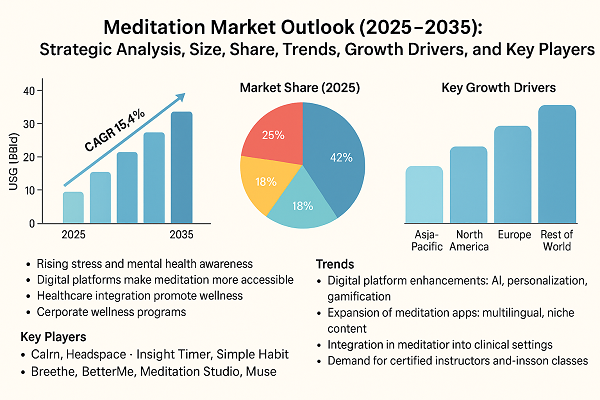
Growth Drivers
- Increasing Mental Health Awareness: Growing recognition of meditation’s benefits for managing stress, anxiety, and depression.
- Technological Advancements: Proliferation of meditation apps (e.g., Calm, Headspace) with AI-driven personalization, virtual reality, and gamification features.
- Corporate Wellness Programs: Companies integrating meditation to enhance employee productivity and well-being.
- Holistic Wellness Trends: Rising consumer preference for non-pharmaceutical mental and physical health solutions.
- Digital Accessibility: Subscription-based and freemium models make meditation widely accessible.
Key Trends
- AI and Personalization: Apps using AI to offer tailored meditation experiences based on user preferences and behavioral data.
- Wearable Integration: Use of biofeedback and wearable devices to enhance meditation practices.
- Sleep Meditation Growth: Increasing demand for apps like Calm and Sleep Cycle addressing sleep-related issues.
- Wellness Retreats: Rising popularity of meditation-focused retreats, such as the Chopra Health Retreat.
- Corporate Adoption: Meditation programs integrated into workplace wellness strategies to reduce stress and improve focus.
Key Players
- Headspace Inc.: Leads with its comprehensive app and innovations like Headspace XR for virtual reality meditation.
- Calm.com Inc.: Valued at USD 2 billion in 2022, known for its extensive content library and strategic partnerships.
- Smiling Mind: Focuses on youth and educational programs, targeting mental health in younger demographics.
- Inner Explorer Inc.: Specializes in mindfulness integration in educational settings.
- Meditopia: Innovates with unique digital experiences, such as art-integrated meditation.
- Other Players: Aura Health, Simple Habit Inc., Waking Up, BetterMe, Insight Network Inc., Mindfulness Everywhere Ltd., Ten Percent Happier, Breethe, Sattva Inc.
Strategic Analysis
- Opportunities:
- Expansion of digital platforms with subscription-based models for recurring revenue.
- Partnerships with healthcare providers to integrate meditation into chronic condition management.
- Growth in wellness tourism, with retreats offering immersive meditation experiences.
- Challenges:
- High competition in the digital space, with many apps offering similar functionalities.
- Cultural barriers in some markets limiting adoption of meditation practices.
- Need for continuous innovation to differentiate in a fragmented market.
- Competitive Strategies:
- Investment in R&D for advanced technologies like AI and VR.
- Strategic partnerships (e.g., Meditopia’s collaboration with Pera Museum) to enhance user engagement.
- Focus on niche markets, such as youth (Smiling Mind) or corporate wellness (Inner Explorer).
Market Segmentation
- By Type: Mindfulness Meditation, Focused Attention, Transcendental Meditation, Zen Meditation, Kundalini Yoga, Metta Meditation.
- By Platform: Apps, Websites, Books, Online Courses, Yoga Centers, Meditation Programs, Workshops.
- By Usage: Individual, Group.
- By End-Use: Home Setting, Corporate, Educational, Healthcare.
- By Information Source: Internet, Articles, Books.
Table of Content
1. Market Overview
1.1 Research Methodology
1.2 Definitions and Scope
2.Market - Executive Summary
2.1 Market Opportunity
2.2 Key Trends by Product Segments
2.3 Key Trends by Geography
3. Meditation Market Landscape
3.1 Comparative analysis
3.1.1 Product Benchmarking - Top 10 companies
3.1.2 Top 5 Financials Analysis
3.1.3 Market Value split by Top 10 companies
3.1.4 Pricing Analysis
4. Market Forces
4.1 Market Drivers
4.2 Market Constraints
4.3 Market Challenges
4.4 Porter’s Five Forces
4.4.1 Bargaining Power of Suppliers
4.4.2 Bargaining Power of Consumers
4.4.3 Threat of New Entrants
4.4.4 Threat of Substitute Products and Services
4.4.5 Degree of Competition
5. Meditation Market - Strategic Analysis
5.1 Value Chain
5.2 Opportunity
5.3 Patent Analysis
6. Global Meditation Market Outlook
6.1 Global Meditation Market Outlook, by Type, 2025-2035
6.2 Global Meditation Market Outlook, by Application, 2025-2035
7. Asia Pacific Meditation Market Outlook
7.1 Key Snapshot
7.2 Asia Pacific Meditation Market Outlook, by Type, 2025-2035
7.3 Asia Pacific Meditation Market Outlook, by Application, 2025-2035
7.4 Asia Pacific Meditation Market Outlook, by Country, 2025-2035
8. North America Meditation Market Outlook
8.1 Key Snapshot
8.2 North America Meditation Market Outlook, by Type, 2025-2035
8.3 North America Meditation Market Outlook, by Application, 2025-2035
8.4 North America Meditation Market Outlook, by Country, 2025-2035
9. Europe Meditation Market Outlook
9.1 Key Snapshot
9.2 Europe Meditation Market Outlook, by Type, 2025-2035
9.3 Europe Meditation Market Outlook, by Application, 2025-2035
9.4 Europe Meditation Market Outlook, by Country, 2025-2035
10. Latin America Meditation Market Outlook
10.1 Key Snapshot
10.2 Latin America Meditation Market Outlook, by Type, 2025-2035
10.3 Latin America Meditation Market Outlook, by Application, 2025-2035
10.4 Latin America Meditation Market Outlook, by Country, 2025-2035
11. Middle East and Africa Meditation Market Outlook
11.1 Key Snapshot
11.2 Middle East and Africa Meditation Market Outlook, by Type, 2025-2035
11.3 Middle East and Africa Meditation Market Outlook, by Application, 2025-2035
11.4 Middle East and Africa Meditation Market Outlook, by Country, 2025-2035
12. Meditation Market -Entropy
12.1 New Product Launches
12.2 M&A, Collaborations, JVs, and Partnerships
13. Meditation Market Company Analysis
13.1 Market Share Analysis, Financial Analysis, Product Synopsis, Recent News and Developments
13.2 Company 1
13.3 Company 2
13.4 Company 3
13.5 Company 4
13.6 Company 5
13.7 Company 6
13.8 Company 7
13.9 Company 8
13.10 Company 9
13.11 Company 10
Related Reports
-
Laser Dentistry Devices Market Report- Global Strategic Analysis, Size, Share, Trend, and Forecast (2025-2035)
- Published: July, 2025
- Price: $2950
- Sample Request
-
Point-of-Care Biopsy Market Report- Global Strategic Analysis, Size, Share, Trend, and Forecast (2025-2035)
- Published: July, 2025
- Price: $2950
- Sample Request
-
Pediatric Patient Handling Equipment Market Report- Global Strategic Analysis, Size, Share, Trend, and Forecast (2025-2035)
- Published: July, 2025
- Price: $2950
- Sample Request
-
Home-Based Molecular Testing Market Report- Global Strategic Analysis, Size, Share, Trend, and Forecast (2025-2035)
- Published: July, 2025
- Price: $2950
- Sample Request