
- Home
- Healthcare
- Antipsychotic Drugs Market
Antipsychotic Drugs Market Report- Global Strategic Analysis, Size, Share, Trend, and Forecast (2022-2029)

Antipsychotic Drugs Market Outlook (2025–2035)
The antipsychotic drugs market is projected to experience steady growth, driven by increasing mental health awareness and advancements in drug formulations. The query specifies a CAGR of 3% and a market value of USD 30 billion in 2035, which aligns with conservative estimates for the global market, considering factors like the rise in generics and regulatory pressures that may moderate growth compared to higher CAGRs in some projections. Below is a comprehensive analysis, excluding regional values.
Market Size and Projections
The global antipsychotic drugs market is forecasted to grow from approximately USD 22.32 billion in 2025 to USD 30 billion by 2035, at a CAGR of 3%. This projection is calculated using the compound growth formula, assuming consistent annual growth. The table below outlines the year-over-year market values (in USD billion):
| Year | Market Value (USD Billion) |
|---|---|
| 2025 | 22.32 |
| 2026 | 22.99 |
| 2027 | 23.68 |
| 2028 | 24.39 |
| 2029 | 25.12 |
| 2030 | 25.87 |
| 2031 | 26.65 |
| 2032 | 27.45 |
| 2033 | 28.27 |
| 2034 | 29.12 |
| 2035 | 30.00 |
Market Share
The market is segmented by drug generation/type, with second-generation (atypical) antipsychotics holding the dominant share due to their improved efficacy and reduced side effects compared to first-generation drugs. In 2025 estimates:
- Second-generation antipsychotics: ~65% share (e.g., risperidone, quetiapine, aripiprazole).
- First-generation antipsychotics: ~20% share (e.g., chlorpromazine, haloperidol).
- Third-generation antipsychotics: ~15% share (e.g., brexpiprazole, cariprazine, growing due to innovations).
By application, schizophrenia accounts for the largest portion (~40-50%), followed by bipolar disorder (~20-30%) and others like major depressive disorder. Long-acting injectables represent a growing subsegment at ~15-20%, valued for better patient compliance.
Trends
- Shift to Generics and Biosimilars: Increasing adoption of cost-effective generics to improve accessibility, especially as patents expire on blockbuster drugs.
- Long-Acting Injectables (LAIs): Rising preference for LAIs to enhance adherence and reduce relapse rates in schizophrenia and bipolar disorder.
- Integration of Digital Health: Use of AI, pharmacogenomics, and telepsychiatry for personalized treatment and monitoring.
- Combination Therapies: Growing use of antipsychotics with mood stabilizers or antidepressants for comorbid conditions.
- Focus on Third-Generation Drugs: Innovations targeting dopamine and serotonin systems with fewer side effects.
Growth Drivers
- Rising Prevalence of Mental Disorders: Increasing cases of schizophrenia, bipolar disorder, and depression, affecting over 1 in 4 people globally, with schizophrenia impacting ~24 million worldwide.
- Aging Population: The global elderly population (60+) is projected to reach 2.1 billion by 2050, heightening demand for antipsychotics in dementia and related conditions.
- Technological Advancements: New formulations like extended-release and AI-driven drug development improving efficacy and compliance.
- Increased Awareness and Access: Government initiatives, telehealth expansion, and reduced stigma boosting diagnosis and treatment rates.
Strategic Analysis
The antipsychotic drugs market is competitive, with players emphasizing R&D for third-generation drugs and LAIs to address side effects like weight gain and metabolic issues. Strategies include partnerships for biosimilar development, expansion into combination therapies, and leveraging digital tools for precision psychiatry. Challenges such as regulatory hurdles, stigma, and over-prescribing require focus on patient-centric innovations and cost reduction through generics. Opportunities lie in emerging markets with rising mental health needs and FDA approvals for novel treatments like Rykindo and REXULTI. Overall, the market favors companies investing in adherence-improving technologies and affordable options.
Key Players
Leading companies in the antipsychotic drugs market include:
- Eli Lilly and Company
- Johnson & Johnson (Janssen Pharmaceuticals)
- Pfizer Inc.
- Otsuka Pharmaceutical Co., Ltd.
- AstraZeneca plc
- Teva Pharmaceutical Industries Ltd.
- Sun Pharmaceutical Industries Ltd.
- AbbVie Inc.
- Bristol-Myers Squibb
- H. Lundbeck A/S
- Novartis AG
- Dr. Reddy's Laboratories
Visualizations
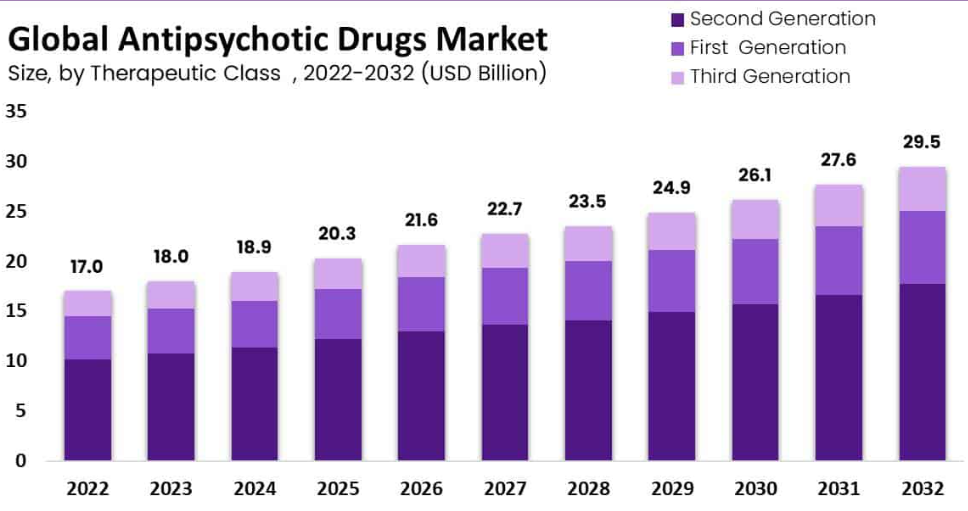
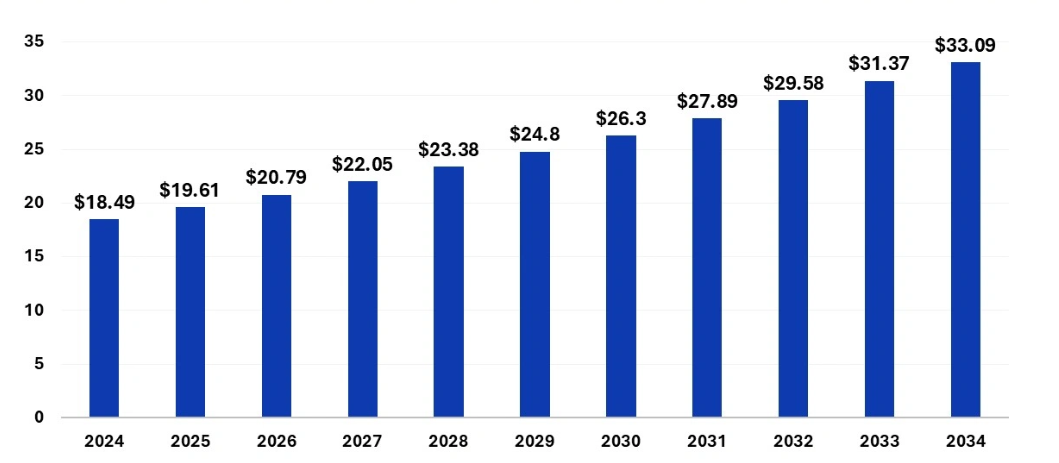
Table of Content
1. Market Overview
1.1 Research Methodology
1.2 Definitions and Scope
2.Market - Executive Summary
2.1 Market Opportunity
2.2 Key Trends by Product Segments
2.3 Key Trends by Geography
3. Antipsychotic Drugs Market Landscape
3.1 Comparative analysis
3.1.1 Product Benchmarking - Top 10 companies
3.1.2 Top 5 Financials Analysis
3.1.3 Market Value split by Top 10 companies
3.1.4 Pricing Analysis
4. Market Forces
4.1 Market Drivers
4.2 Market Constraints
4.3 Market Challenges
4.4 Porter’s Five Forces
4.4.1 Bargaining Power of Suppliers
4.4.2 Bargaining Power of Consumers
4.4.3 Threat of New Entrants
4.4.4 Threat of Substitute Products and Services
4.4.5 Degree of Competition
5. Antipsychotic Drugs Market - Strategic Analysis
5.1 Value Chain
5.2 Opportunity
5.3 Patent Analysis
6. Global Antipsychotic Drugs Market Outlook
6.1 Global Antipsychotic Drugs Market Outlook, by Type, 2019-2029
6.2 Global Antipsychotic Drugs Market Outlook, by Application, 2019-2029
7. Asia Pacific Antipsychotic Drugs Market Outlook
7.1 Key Snapshot
7.2 Asia Pacific Antipsychotic Drugs Market Outlook, by Type, 2019-2029
7.3 Asia Pacific Antipsychotic Drugs Market Outlook, by Application, 2019-2029
7.4 Asia Pacific Antipsychotic Drugs Market Outlook, by Country, 2019-2029
8. North America Antipsychotic Drugs Market Outlook
8.1 Key Snapshot
8.2 North America Antipsychotic Drugs Market Outlook, by Type, 2019-2029
8.3 North America Antipsychotic Drugs Market Outlook, by Application, 2019-2029
8.4 North America Antipsychotic Drugs Market Outlook, by Country, 2019-2029
9. Europe Antipsychotic Drugs Market Outlook
9.1 Key Snapshot
9.2 Europe Antipsychotic Drugs Market Outlook, by Type, 2019-2029
9.3 Europe Antipsychotic Drugs Market Outlook, by Application, 2019-2029
9.4 Europe Antipsychotic Drugs Market Outlook, by Country, 2019-2029
10. Latin America Antipsychotic Drugs Market Outlook
10.1 Key Snapshot
10.2 Latin America Antipsychotic Drugs Market Outlook, by Type, 2019-2029
10.3 Latin America Antipsychotic Drugs Market Outlook, by Application, 2019-2029
10.4 Latin America Antipsychotic Drugs Market Outlook, by Country, 2019-2029
11. Middle East and Africa Antipsychotic Drugs Market Outlook
11.1 Key Snapshot
11.2 Middle East and Africa Antipsychotic Drugs Market Outlook, by Type, 2019-2029
11.3 Middle East and Africa Antipsychotic Drugs Market Outlook, by Application, 2019-2029
11.4 Middle East and Africa Antipsychotic Drugs Market Outlook, by Country, 2019-2029
12. Antipsychotic Drugs Market -Entropy
12.1 New Product Launches
12.2 M&A, Collaborations, JVs, and Partnerships
13. Antipsychotic Drugs Market Company Analysis
13.1 Market Share Analysis, Financial Analysis, Product Synopsis, Recent News and Developments
13.2 Company 1
13.3 Company 2
13.4 Company 3
13.5 Company 4
13.6 Company 5
13.7 Company 6
13.8 Company 7
13.9 Company 8
13.10 Company 9
13.11 Company 10
Related Reports
-
Laser Dentistry Devices Market Report- Global Strategic Analysis, Size, Share, Trend, and Forecast (2025-2035)
- Published: July, 2025
- Price: $2950
- Sample Request
-
Meditation Market Report- Global Strategic Analysis, Size, Share, Trend, and Forecast (2025-2035)
- Published: July, 2025
- Price: $2950
- Sample Request
-
Point-of-Care Biopsy Market Report- Global Strategic Analysis, Size, Share, Trend, and Forecast (2025-2035)
- Published: July, 2025
- Price: $2950
- Sample Request
-
Pediatric Patient Handling Equipment Market Report- Global Strategic Analysis, Size, Share, Trend, and Forecast (2025-2035)
- Published: July, 2025
- Price: $2950
- Sample Request