
- Home
- Healthcare
- Computer Vision in Healthcare Market
Computer Vision in Healthcare Market Report- Global Strategic Analysis, Size, Share, Trend, and Forecast (2025-2035)

Market Overview
The global computer vision in healthcare market is projected to grow at a compound annual growth rate (CAGR) of 25.80% from 2025 to 2035, reaching a market value of USD 26.73 billion by 2035. This growth is driven by the increasing adoption of artificial intelligence (AI) and machine learning (ML) in healthcare, particularly for medical imaging, diagnostics, and surgical assistance.
Strategic Analysis
Market Size and Share
- 2025 Market Value: Estimated at USD 3.77 billion to USD 4.86 billion across various sources.
- 2035 Market Value: Projected to reach USD 26.73 billion.
- Market Share by Component (2024):
- Software: Largest share due to integration with AI and ML for diagnostics.
- Hardware: Significant share, driven by demand for high-performance GPUs and processors.
- Services: Growing due to increased need for consulting and implementation.
Trends
- AI-Powered Diagnostics: Enhanced accuracy in analyzing medical images (e.g., X-rays, MRIs, CT scans) for early disease detection.
- Telemedicine Integration: Surge in computer vision for remote patient monitoring, accelerated by post-COVID telehealth adoption.
- Surgical Assistance: Real-time guidance for surgeons using computer vision in robotic-assisted surgeries.
- Precision Medicine: Growing use of computer vision for personalized treatment plans based on visual data analysis.
- Edge Computing: Adoption of edge-based AI solutions for real-time processing in medical devices.
Growth Drivers
- Rising Chronic Disease Prevalence: Increasing need for early diagnosis of conditions like cancer and cardiovascular diseases.
- AI and ML Advancements: Improved algorithms enhance diagnostic accuracy and reduce errors.
- Government Initiatives: Policies promoting AI adoption in healthcare, such as FDA and EMA frameworks for AI-enabled devices.
- Healthcare Data Growth: Exponential increase in medical imaging data necessitating automated analysis.
- Investment in Digital Health: Significant funding for AI and computer vision startups, with examples like GE Healthcare’s USD 2.2 billion R&D investment since 2022.
Challenges
- Data Privacy and Security: Concerns over patient data protection and compliance with regulations like HIPAA and GDPR.
- Lack of Standardization: Variability in algorithms and systems hinders interoperability.
- High Implementation Costs: Expensive hardware and software solutions limit adoption in smaller facilities.
- Algorithm Reliability: Ensuring accuracy in complex medical imaging to avoid critical errors.
Key Players
- NVIDIA Corporation: Dominates with GPUs and AI platforms like NVIDIA Clara.
- Microsoft Corporation: Integrates computer vision in Azure AI for healthcare solutions.
- Google LLC: Advances AI-driven diagnostics with tools like DeepMind for retinal analysis.
- IBM Corporation: Offers Watson Health for imaging and diagnostics.
- General Electric (GE): Invests in AI-enabled imaging solutions.
- Others: AiCure, Arterys, Basler AG, iCAD Inc., Intel Corporation, Insoftex, Robovision BV, SenseTime.
Market Segmentation
By Component
- Software: Leading segment, driven by AI-powered diagnostic tools (e.g., LandingLens by Landing AI).
- Hardware: Includes GPUs, CPUs, and smart cameras, with NVIDIA’s H100 Tensor Core GPU leading performance.
- Services: Consulting, integration, and maintenance services for system deployment.
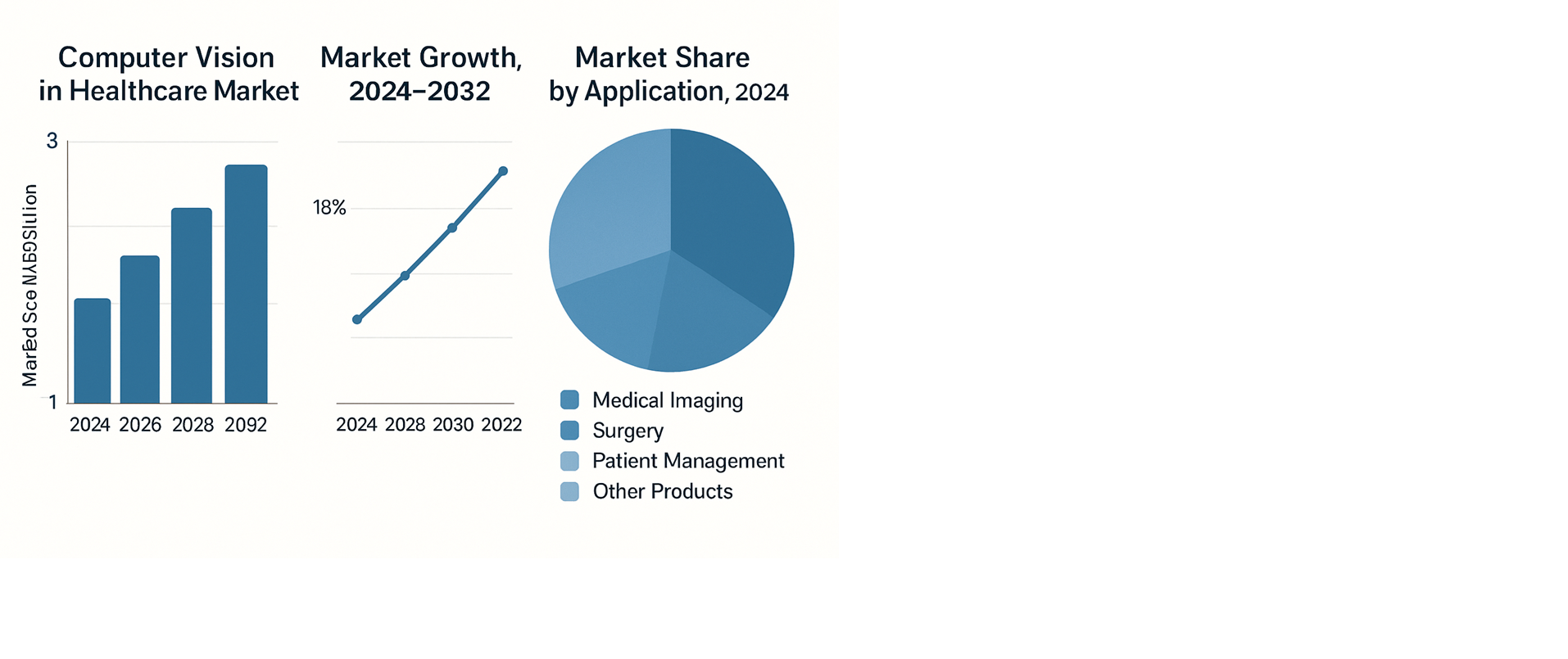
By Application
- Medical Imaging and Diagnostics: Largest segment, used for analyzing X-rays, MRIs, and CT scans.
- Surgical Assistance: Growing due to real-time guidance in robotic surgeries.
- Patient Monitoring: Increasing in telemedicine and remote care.
- Drug Discovery: Emerging use in analyzing molecular structures.
By End User
- Hospitals and Clinics: Dominant due to advanced imaging and surgical capabilities.
- Diagnostic Centers: Fast-growing, leveraging computer vision for rapid diagnostics.
- Research Institutes: Focused on developing new applications and algorithms.
- Others: Includes telehealth providers and specialty clinics.
By Deployment Mode
- Cloud-Based: Fastest-growing, offering scalability and remote access.
- On-Premises: Preferred by facilities requiring high data security.
Strategic Recommendations
- Invest in AI R&D: Focus on developing robust algorithms for complex imaging tasks.
- Enhance Data Security: Implement advanced encryption and compliance measures to address privacy concerns.
- Forge Strategic Partnerships: Collaborate with healthcare providers and tech firms to expand market reach (e.g., Microsoft-NVIDIA partnership in March 2024).
- Target Telemedicine: Develop solutions tailored for remote diagnostics and patient monitoring.
- Reduce Costs: Innovate cost-effective hardware and cloud-based solutions for smaller facilities.
Table of Content
1. Market Overview
1.1 Research Methodology
1.2 Definitions and Scope
2.Market - Executive Summary
2.1 Market Opportunity
2.2 Key Trends by Product Segments
2.3 Key Trends by Geography
3. Computer Vision in Healthcare Market Landscape
3.1 Comparative analysis
3.1.1 Product Benchmarking - Top 10 companies
3.1.2 Top 5 Financials Analysis
3.1.3 Market Value split by Top 10 companies
3.1.4 Pricing Analysis
4. Market Forces
4.1 Market Drivers
4.2 Market Constraints
4.3 Market Challenges
4.4 Porter’s Five Forces
4.4.1 Bargaining Power of Suppliers
4.4.2 Bargaining Power of Consumers
4.4.3 Threat of New Entrants
4.4.4 Threat of Substitute Products and Services
4.4.5 Degree of Competition
5. Computer Vision in Healthcare Market - Strategic Analysis
5.1 Value Chain
5.2 Opportunity
5.3 Patent Analysis
6. Global Computer Vision in Healthcare Market Outlook
6.1 Global Computer Vision in Healthcare Market Outlook, by Type, 2025-2035
6.2 Global Computer Vision in Healthcare Market Outlook, by Application, 2025-2035
7. Asia Pacific Computer Vision in Healthcare Market Outlook
7.1 Key Snapshot
7.2 Asia Pacific Computer Vision in Healthcare Market Outlook, by Type, 2025-2035
7.3 Asia Pacific Computer Vision in Healthcare Market Outlook, by Application, 2025-2035
7.4 Asia Pacific Computer Vision in Healthcare Market Outlook, by Country, 2025-2035
8. North America Computer Vision in Healthcare Market Outlook
8.1 Key Snapshot
8.2 North America Computer Vision in Healthcare Market Outlook, by Type, 2025-2035
8.3 North America Computer Vision in Healthcare Market Outlook, by Application, 2025-2035
8.4 North America Computer Vision in Healthcare Market Outlook, by Country, 2025-2035
9. Europe Computer Vision in Healthcare Market Outlook
9.1 Key Snapshot
Related Reports
-
Laser Dentistry Devices Market Report- Global Strategic Analysis, Size, Share, Trend, and Forecast (2025-2035)
- Published: July, 2025
- Price: $2950
- Sample Request
-
Meditation Market Report- Global Strategic Analysis, Size, Share, Trend, and Forecast (2025-2035)
- Published: July, 2025
- Price: $2950
- Sample Request
-
Point-of-Care Biopsy Market Report- Global Strategic Analysis, Size, Share, Trend, and Forecast (2025-2035)
- Published: July, 2025
- Price: $2950
- Sample Request
-
Pediatric Patient Handling Equipment Market Report- Global Strategic Analysis, Size, Share, Trend, and Forecast (2025-2035)
- Published: July, 2025
- Price: $2950
- Sample Request