
- Home
- Healthcare
- Fitness Tracker Market
Fitness Tracker Market Report- Global Strategic Analysis, Size, Share, Trend, and Forecast (2022-2029)

Market Overview
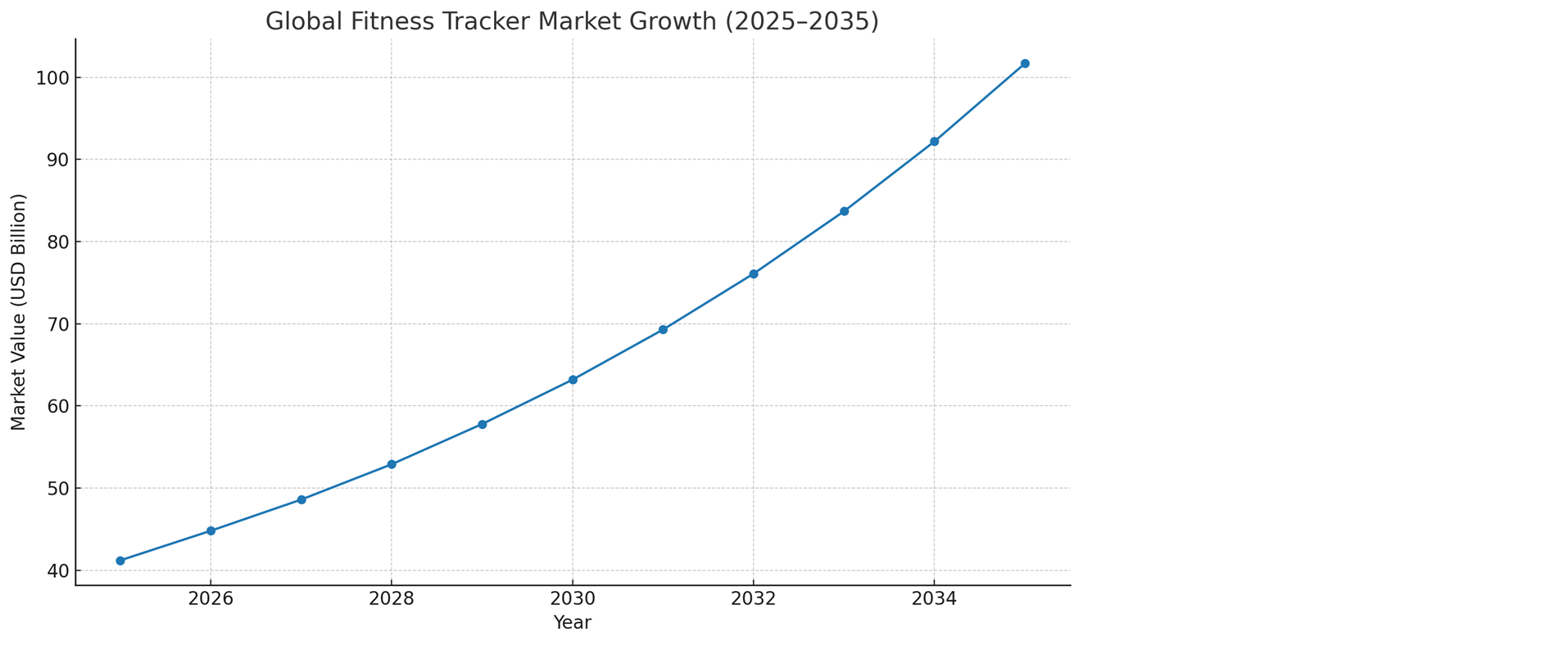
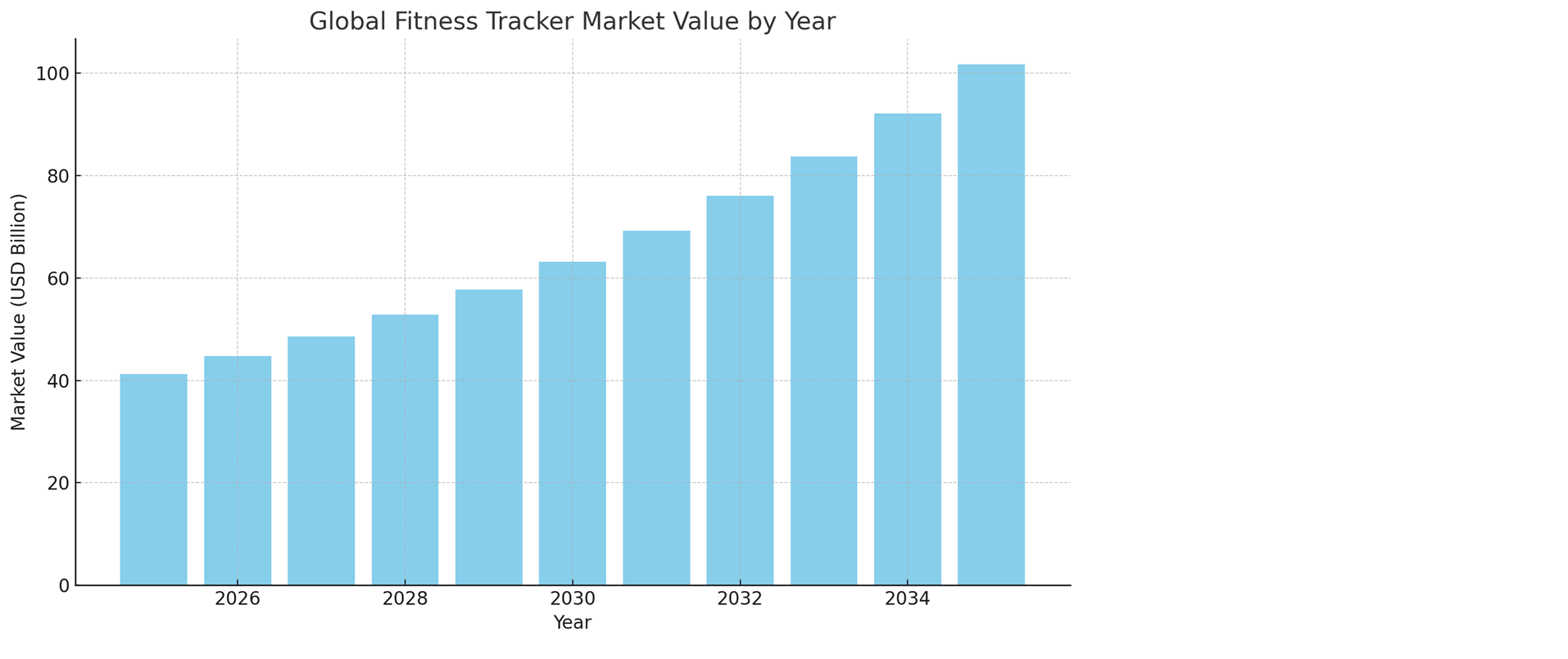
The global fitness tracker market is projected to grow at a compound annual growth rate (CAGR) of 16% from 2025 to 2035, reaching a market value of USD 323 billion by 2035. This growth is driven by increasing health consciousness, technological advancements, and the integration of fitness trackers with smartphones and other smart devices.
Market Size and Share
-
2024 Market Size: Estimated at USD 62.92 billion.
-
2025 Projected Size: Expected to reach USD 75.90 billion.
-
2035 Projected Size: Forecasted to reach USD 323 billion with a CAGR of 16%.
-
Market Share by Product Type (2024):
-
Wearable Fitness Trackers: 32.8% (USD 1.49 billion)
-
Smartwatches: 27.1% (USD 1.23 billion)
-
Fitness Bands: 28.6% (USD 1.3 billion)
-
Heart Rate Monitors: 20.7% (USD 0.94 billion)
-
-
Projected Market Share by 2035:
-
Wearable Fitness Trackers: Expected to reach USD 4.5 billion
-
Smartwatches: USD 3.7 billion
-
Fitness Bands: USD 4.0 billion
-
Heart Rate Monitors: USD 2.8 billion
-
Trends
-
Technological Advancements: Integration of advanced sensors for heart rate, blood oxygen, and ECG monitoring.
-
Health Consciousness: Rising awareness of health and wellness, particularly among Gen-Z and millennials, drives demand.
-
Smartphone Integration: Enhanced user experience through seamless connectivity with smartphone apps.
-
E-commerce Growth: Online distribution channels accounted for 65.1% of revenue share in 2024, driven by convenience and variety.
-
Sports-Specific Trackers: Increased demand for trackers tailored for activities like running and cycling.
Growth Drivers
-
Increasing Prevalence of Chronic Diseases: Rising cases of obesity, diabetes, and cardiovascular diseases fuel demand for health monitoring devices.
-
Innovative Features: Development of features like sleep tracking, stress detection, and GPS enhances consumer appeal.
-
Rising Disposable Incomes: Higher purchasing power in emerging markets supports market expansion.
-
Partnerships and Collaborations: Strategic alliances, such as Fitbit’s collaboration with Quest Diagnostics, drive innovation.
-
IoT and Connected Devices: Integration with the Internet of Things (IoT) improves device functionality and user engagement.
Challenges
-
Data Privacy Concerns: Issues related to the security of personal health data may hinder adoption.
-
High Competition: Fragmented market with numerous players increases competitive pressure.
-
Cost of Advanced Devices: Premium features may limit affordability for some consumers.
-
Regulatory Hurdles: Stringent regulations on health data and device approvals pose challenges.
Key Players
-
Apple Inc.
-
Fitbit Inc. (Google LLC)
-
Garmin Ltd.
-
Xiaomi Corporation
-
Huawei Technologies Co., Ltd.
-
Samsung Electronics Co., Ltd.
-
Nike, Inc.
-
Polar Electro Oy
-
Fossil Group, Inc.
-
Sony Corporation
Market Segmentation
-
By Product Type: Wearable Fitness Trackers, Smartwatches, Fitness Bands, Heart Rate Monitors
-
By Application: Running, Sports, Cycling Tracking, Glucose Monitoring, Heart Rate Tracking, Sleep Monitoring
-
By Distribution Channel: Online, Offline
-
Strategic Analysis
-
Innovation Focus: Companies are investing in R&D to develop advanced features like AI-driven analytics and personalized health insights.
-
Mergers and Acquisitions: Google’s acquisition of Fitbit for USD 2.1 billion in 2021 expanded its market presence.
-
Consumer Engagement: Emphasis on user-friendly interfaces and gamification to maintain consumer interest.
-
Conclusion
-
The fitness tracker market is poised for robust growth through 2035, driven by technological innovation, rising health awareness, and strategic partnerships. However, challenges like data privacy and high competition necessitate continuous innovation and strategic planning by key players to sustain market growth.
-
Healthcare Integration: Collaborations with healthcare providers to integrate trackers into chronic disease management systems.
Table of Content
1. Market Overview
1.1 Research Methodology
1.2 Definitions and Scope
2.Market - Executive Summary
2.1 Market Opportunity
2.2 Key Trends by Product Segments
2.3 Key Trends by Geography
3. Fitness Tracker Market Landscape
3.1 Comparative analysis
3.1.1 Product Benchmarking - Top 10 companies
3.1.2 Top 5 Financials Analysis
3.1.3 Market Value split by Top 10 companies
3.1.4 Pricing Analysis
4. Market Forces
4.1 Market Drivers
4.2 Market Constraints
4.3 Market Challenges
4.4 Porter’s Five Forces
4.4.1 Bargaining Power of Suppliers
4.4.2 Bargaining Power of Consumers
4.4.3 Threat of New Entrants
4.4.4 Threat of Substitute Products and Services
4.4.5 Degree of Competition
5. Fitness Tracker Market - Strategic Analysis
5.1 Value Chain
5.2 Opportunity
5.3 Patent Analysis
6. Global Fitness Tracker Market Outlook
6.1 Global Fitness Tracker Market Outlook, by Type, 2019-2029
6.2 Global Fitness Tracker Market Outlook, by Application, 2019-2029
7. Asia Pacific Fitness Tracker Market Outlook
7.1 Key Snapshot
7.2 Asia Pacific Fitness Tracker Market Outlook, by Type, 2019-2029
7.3 Asia Pacific Fitness Tracker Market Outlook, by Application, 2019-2029
7.4 Asia Pacific Fitness Tracker Market Outlook, by Country, 2019-2029
8. North America Fitness Tracker Market Outlook
8.1 Key Snapshot
8.2 North America Fitness Tracker Market Outlook, by Type, 2019-2029
8.3 North America Fitness Tracker Market Outlook, by Application, 2019-2029
8.4 North America Fitness Tracker Market Outlook, by Country, 2019-2029
9. Europe Fitness Tracker Market Outlook
9.1 Key Snapshot
9.2 Europe Fitness Tracker Market Outlook, by Type, 2019-2029
9.3 Europe Fitness Tracker Market Outlook, by Application, 2019-2029
9.4 Europe Fitness Tracker Market Outlook, by Country, 2019-2029
10. Latin America Fitness Tracker Market Outlook
10.1 Key Snapshot
10.2 Latin America Fitness Tracker Market Outlook, by Type, 2019-2029
10.3 Latin America Fitness Tracker Market Outlook, by Application, 2019-2029
10.4 Latin America Fitness Tracker Market Outlook, by Country, 2019-2029
11. Middle East and Africa Fitness Tracker Market Outlook
11.1 Key Snapshot
11.2 Middle East and Africa Fitness Tracker Market Outlook, by Type, 2019-2029
11.3 Middle East and Africa Fitness Tracker Market Outlook, by Application, 2019-2029
11.4 Middle East and Africa Fitness Tracker Market Outlook, by Country, 2019-2029
12. Fitness Tracker Market -Entropy
12.1 New Product Launches
12.2 M&A, Collaborations, JVs, and Partnerships
13. Fitness Tracker Market Company Analysis
13.1 Market Share Analysis, Financial Analysis, Product Synopsis, Recent News and Developments
13.2 Company 1
13.3 Company 2
13.4 Company 3
13.5 Company 4
13.6 Company 5
13.7 Company 6
13.8 Company 7
13.9 Company 8
13.10 Company 9
13.11 Company 10
Related Reports
-
Laser Dentistry Devices Market Report- Global Strategic Analysis, Size, Share, Trend, and Forecast (2025-2035)
- Published: July, 2025
- Price: $2950
- Sample Request
-
Meditation Market Report- Global Strategic Analysis, Size, Share, Trend, and Forecast (2025-2035)
- Published: July, 2025
- Price: $2950
- Sample Request
-
Point-of-Care Biopsy Market Report- Global Strategic Analysis, Size, Share, Trend, and Forecast (2025-2035)
- Published: July, 2025
- Price: $2950
- Sample Request
-
Pediatric Patient Handling Equipment Market Report- Global Strategic Analysis, Size, Share, Trend, and Forecast (2025-2035)
- Published: July, 2025
- Price: $2950
- Sample Request