
- Home
- Healthcare
- Non steroidal Anti inflammatory Drugs market
Non-steroidal Anti-inflammatory Drugs Market Report- Global Strategic Analysis, Size, Share, Trend, and Forecast (2022-2029)

Market Overview
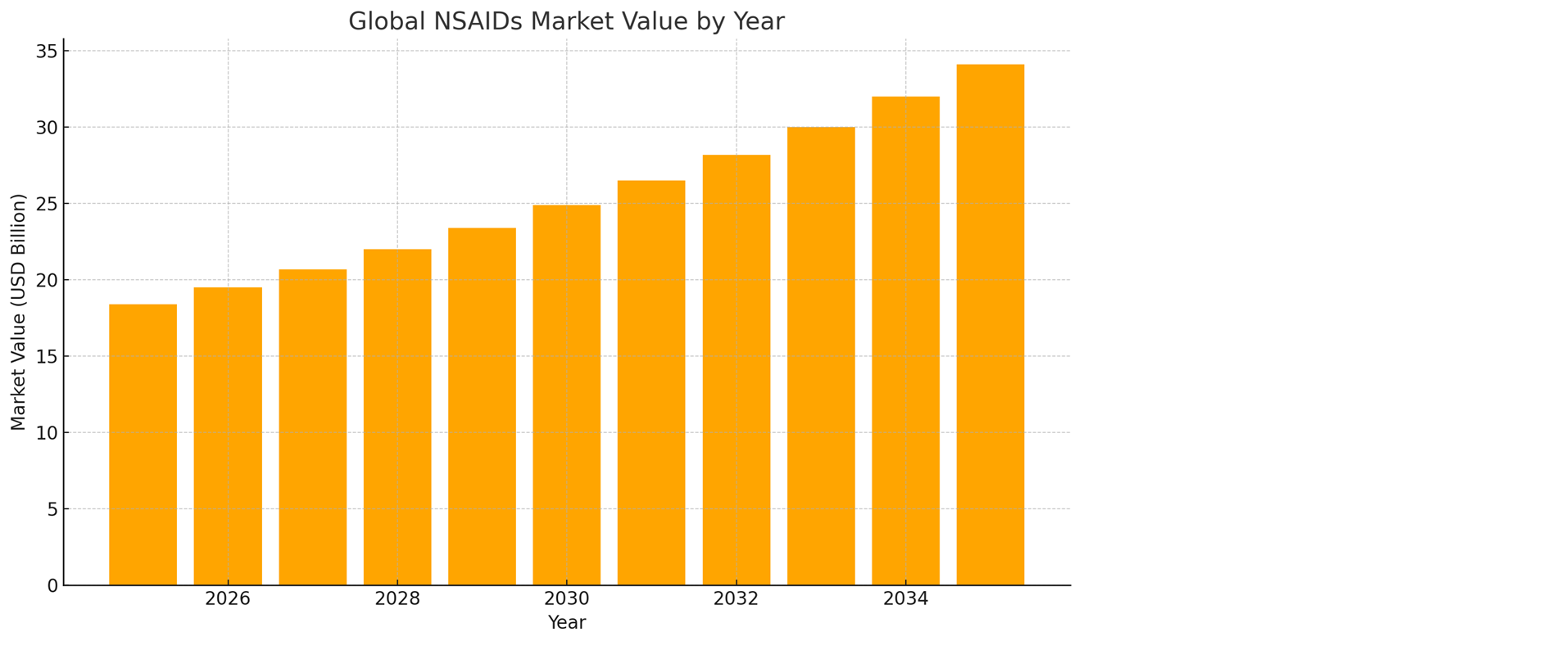
The global non-steroidal anti-inflammatory drugs (NSAIDs) market is projected to grow at a compound annual growth rate (CAGR) of 7.2% from 2025 to 2035, reaching a market value of USD 396.30 billion by 2035. This growth is driven by the rising prevalence of chronic pain, increasing geriatric population, and growing demand for over-the-counter (OTC) NSAIDs.
Market Size and Share
-
2024 Market Size: Estimated at USD 24.61 billion (based on 2024 estimates and CAGR projections).
-
2025 Projected Size: Expected to reach USD 26.38 billion.
-
2035 Projected Size: Forecasted to reach USD 396.30 billion with a CAGR of 7.2%.
-
Market Share by Disease Indication (2024):
-
Arthritis: 45.0% (USD 11.07 billion)
-
Migraine: 20.5% (USD 5.05 billion)
-
Musculoskeletal Pain: 18.7% (USD 4.60 billion)
-
Others (e.g., menstrual pain, dental pain): 15.8% (USD 3.89 billion)
-
-
Projected Market Share by 2035:
-
Arthritis: Expected to reach USD 178.34 billion
-
Migraine: USD 81.24 billion
-
Musculoskeletal Pain: USD 74.11 billion
-
Others: USD 62.61 billion
-
Trends
-
Shift to OTC NSAIDs: Growing consumer preference for self-medication and OTC options due to convenience and accessibility.
-
Topical NSAIDs Growth: Increasing popularity of gels and creams for localized pain relief with fewer systemic side effects.
-
Digital Health Integration: Telemedicine and digital health platforms facilitate easier access to NSAID prescriptions.
-
Combination Therapies: Rising adoption of combination NSAIDs for enhanced efficacy in treating complex conditions.
-
Selective COX-2 Inhibitors: Research and development focus on safer NSAIDs with reduced gastrointestinal risks.
Growth Drivers
-
Rising Prevalence of Chronic Pain: Increasing cases of arthritis, migraines, and musculoskeletal disorders drive demand. Over 350 million arthritis cases globally are estimated in 2024.
-
Aging Population: The growing geriatric population, more prone to chronic conditions like osteoarthritis, boosts NSAID usage.
-
OTC Accessibility: Regulatory approvals for OTC NSAIDs enhance market reach and consumer adoption.
-
Product Innovation: New formulations, such as fast-acting oral solutions (e.g., ELYXYB for migraines), improve patient outcomes.
-
Government Initiatives: Programs like the NIH’s HEAL initiative support pain management research, indirectly boosting the market.
Challenges
-
Side Effect Concerns: Long-term NSAID use is associated with risks like gastrointestinal bleeding and cardiovascular issues.
-
Regulatory Hurdles: Stringent regulations for drug approvals may delay market entry for new products.
-
Competition: High market fragmentation with numerous players increases competitive pressure.
-
Opioid Alternatives: While NSAIDs are preferred over opioids, alternative therapies like biologics pose competition.
Key Players
-
Pfizer Inc.
-
Johnson & Johnson Services, Inc.
-
GlaxoSmithKline PLC
-
Bayer AG
-
Dr. Reddy’s Laboratories Ltd.
-
Merck & Co., Inc.
-
Teva Pharmaceutical Industries Ltd.
-
Sanofi S.A.
-
AstraZeneca PLC
-
Eli Lilly and Company
Market Segmentation
-
By Disease Indication: Arthritis, Migraine, Musculoskeletal Pain, Others (e.g., menstrual pain, dental pain)
-
By Route of Administration: Oral, Topical, Injectable
-
By Distribution Channel: Retail Pharmacy, Hospital Pharmacy, Online Pharmacy
Strategic Analysis
-
Innovation Focus: Companies are investing in R&D for safer NSAIDs, such as selective COX-2 inhibitors, to minimize side effects.
-
Geographical Expansion: Key players like Dr. Reddy’s and Alkem Labs are expanding into markets like the U.S. to increase share.
-
OTC Market Growth: Increasing approvals for OTC NSAIDs enhance accessibility and drive sales.
-
Conclusion
The NSAIDs market is set for significant growth through 2035, driven by chronic pain prevalence, an aging population, and innovative product launches. However, challenges like side effect concerns and regulatory hurdles require strategic innovation and compliance to sustain market momentum.
-
Partnerships: Collaborations, such as Dr. Reddy’s partnership with HK inno.N for Tegoprazan, foster innovation.
-
Consumer Behavior: Rising trend of self-medication and awareness of NSAID benefits boost demand.
Table of Content
1. Market Overview
1.1 Research Methodology
1.2 Definitions and Scope
2.Market - Executive Summary
2.1 Market Opportunity
2.2 Key Trends by Product Segments
2.3 Key Trends by Geography
3. Non-steroidal Anti-inflammatory Drugs Market Landscape
3.1 Comparative analysis
3.1.1 Product Benchmarking - Top 10 companies
3.1.2 Top 5 Financials Analysis
3.1.3 Market Value split by Top 10 companies
3.1.4 Pricing Analysis
4. Market Forces
4.1 Market Drivers
4.2 Market Constraints
4.3 Market Challenges
4.4 Porter’s Five Forces
4.4.1 Bargaining Power of Suppliers
4.4.2 Bargaining Power of Consumers
4.4.3 Threat of New Entrants
4.4.4 Threat of Substitute Products and Services
4.4.5 Degree of Competition
5. Non-steroidal Anti-inflammatory Drugs Market - Strategic Analysis
5.1 Value Chain
5.2 Opportunity
5.3 Patent Analysis
6. Global Non-steroidal Anti-inflammatory Drugs Market Outlook
6.1 Global Non-steroidal Anti-inflammatory Drugs Market Outlook, by Type, 2019-2029
6.2 Global Non-steroidal Anti-inflammatory Drugs Market Outlook, by Application, 2019-2029
7. Asia Pacific Non-steroidal Anti-inflammatory Drugs Market Outlook
7.1 Key Snapshot
7.2 Asia Pacific Non-steroidal Anti-inflammatory Drugs Market Outlook, by Type, 2019-2029
7.3 Asia Pacific Non-steroidal Anti-inflammatory Drugs Market Outlook, by Application, 2019-2029
7.4 Asia Pacific Non-steroidal Anti-inflammatory Drugs Market Outlook, by Country, 2019-2029
8. North America Non-steroidal Anti-inflammatory Drugs Market Outlook
8.1 Key Snapshot
8.2 North America Non-steroidal Anti-inflammatory Drugs Market Outlook, by Type, 2019-2029
8.3 North America Non-steroidal Anti-inflammatory Drugs Market Outlook, by Application, 2019-2029
8.4 North America Non-steroidal Anti-inflammatory Drugs Market Outlook, by Country, 2019-2029
9. Europe Non-steroidal Anti-inflammatory Drugs Market Outlook
9.1 Key Snapshot
9.2 Europe Non-steroidal Anti-inflammatory Drugs Market Outlook, by Type, 2019-2029
9.3 Europe Non-steroidal Anti-inflammatory Drugs Market Outlook, by Application, 2019-2029
9.4 Europe Non-steroidal Anti-inflammatory Drugs Market Outlook, by Country, 2019-2029
10. Latin America Non-steroidal Anti-inflammatory Drugs Market Outlook
10.1 Key Snapshot
10.2 Latin America Non-steroidal Anti-inflammatory Drugs Market Outlook, by Type, 2019-2029
10.3 Latin America Non-steroidal Anti-inflammatory Drugs Market Outlook, by Application, 2019-2029
10.4 Latin America Non-steroidal Anti-inflammatory Drugs Market Outlook, by Country, 2019-2029
11. Middle East and Africa Non-steroidal Anti-inflammatory Drugs Market Outlook
11.1 Key Snapshot
11.2 Middle East and Africa Non-steroidal Anti-inflammatory Drugs Market Outlook, by Type, 2019-2029
11.3 Middle East and Africa Non-steroidal Anti-inflammatory Drugs Market Outlook, by Application, 2019-2029
11.4 Middle East and Africa Non-steroidal Anti-inflammatory Drugs Market Outlook, by Country, 2019-2029
12. Non-steroidal Anti-inflammatory Drugs Market -Entropy
12.1 New Product Launches
12.2 M&A, Collaborations, JVs, and Partnerships
13. Non-steroidal Anti-inflammatory Drugs Market Company Analysis
13.1 Market Share Analysis, Financial Analysis, Product Synopsis, Recent News and Developments
13.2 Company 1
13.3 Company 2
13.4 Company 3
13.5 Company 4
13.6 Company 5
13.7 Company 6
13.8 Company 7
13.9 Company 8
13.10 Company 9
13.11 Company 10
Related Reports
-
Laser Dentistry Devices Market Report- Global Strategic Analysis, Size, Share, Trend, and Forecast (2025-2035)
- Published: July, 2025
- Price: $2950
- Sample Request
-
Meditation Market Report- Global Strategic Analysis, Size, Share, Trend, and Forecast (2025-2035)
- Published: July, 2025
- Price: $2950
- Sample Request
-
Point-of-Care Biopsy Market Report- Global Strategic Analysis, Size, Share, Trend, and Forecast (2025-2035)
- Published: July, 2025
- Price: $2950
- Sample Request
-
Pediatric Patient Handling Equipment Market Report- Global Strategic Analysis, Size, Share, Trend, and Forecast (2025-2035)
- Published: July, 2025
- Price: $2950
- Sample Request