
- Home
- Food & Beverage
- Organic Beer Market
Organic Beer Market Report- Global Strategic Analysis, Size, Share, Trend, and Forecast (2025-2035)

Market Overview
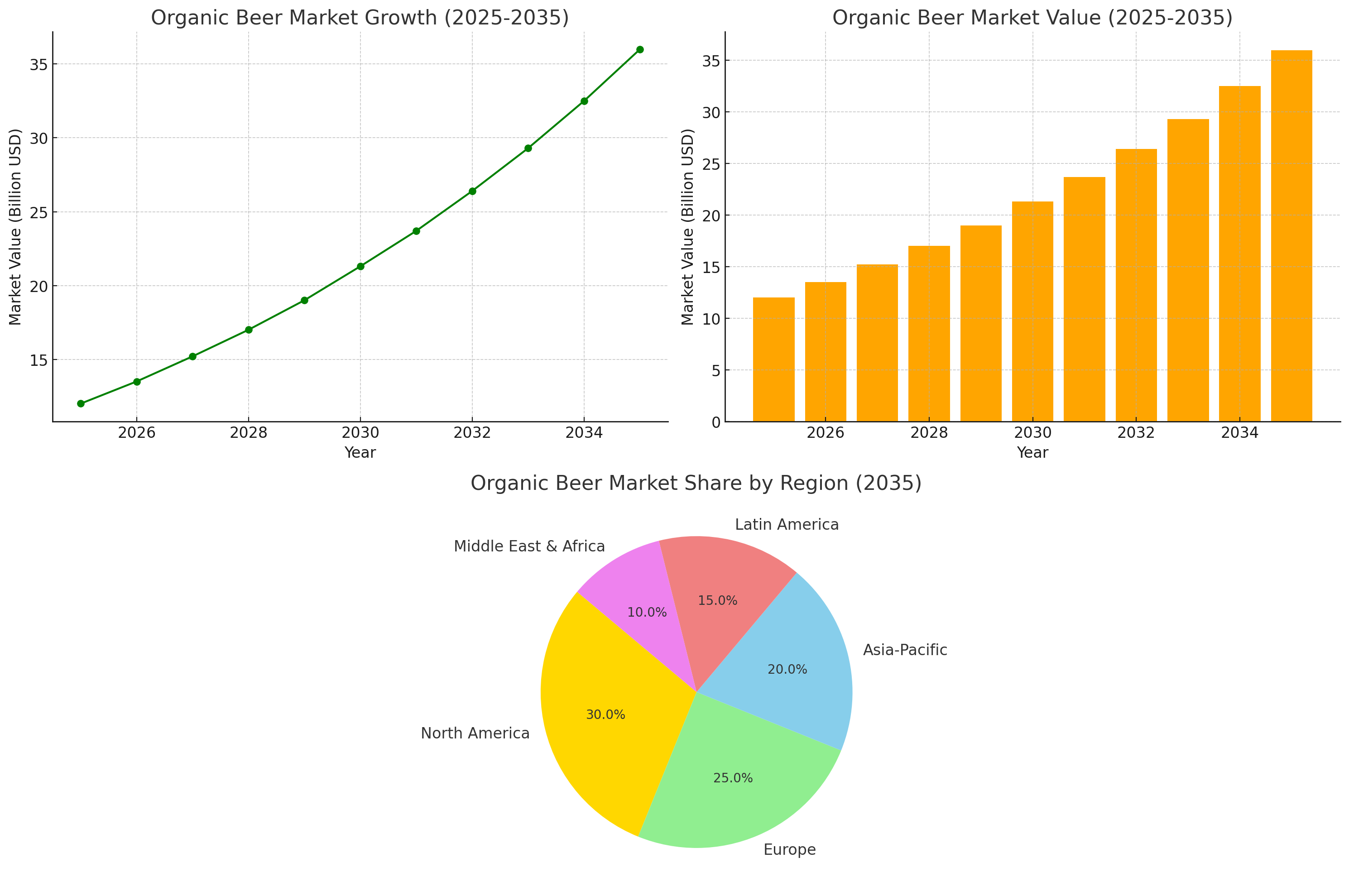
The global organic beer market is projected to grow significantly, reaching a market value of USD 20.94 billion by 2035, with a compound annual growth rate (CAGR) of 7.6% from 2025 to 2035. This growth is driven by increasing consumer demand for healthier, sustainable, and eco-friendly beverage options, alongside rising awareness of organic products' environmental and health benefits.
Market Size and Share
-
Market Size in 2025: Estimated at USD 9.39 billion (derived from projected growth to USD 20.94 billion by 2035 at 7.6% CAGR).
-
Market Size in 2035: Forecasted to reach USD 20.94 billion.
-
Market Share by Type (2025):
-
Lager: Dominates with approximately 45% of the market, driven by its crisp, clean taste and broad consumer appeal.
-
Ale: Accounts for around 30%, popular among craft beer enthusiasts for its diverse flavor profiles.
-
Stouts and Porters: Hold about 15%, appealing to consumers seeking bold, robust flavors.
-
Specialty Beers: Represent 10%, including fruit-infused, gluten-free, and non-alcoholic organic beers, catering to niche dietary preferences.
-
Trends
-
Health and Wellness: Growing consumer preference for organic beers made with natural ingredients, free from synthetic pesticides, fertilizers, and GMOs.
-
Sustainability: Increased focus on eco-friendly brewing practices, sustainable packaging, and organic certifications.
-
Non-Alcoholic Organic Beer: Rising demand for alcohol-free options, with innovations like Patagonia Provisions and Deschutes Brewery’s non-alcoholic Kernza Golden Brew.
-
Craft Brewery Expansion: Small and independent breweries are driving innovation, offering unique flavors and organic options.
-
E-commerce Growth: Online stores are the fastest-growing distribution channel, fueled by convenience and broader product access.
Growth Drivers
-
Consumer Awareness: Increasing knowledge of organic products' health and environmental benefits boosts demand.
-
Rising Disposable Income: Higher spending power enables consumers to opt for premium organic beers.
-
Environmental Concerns: Support for sustainable farming and eco-friendly brewing practices drives market expansion.
-
Product Innovation: Breweries are introducing organic beers with unique flavors and non-alcoholic variants to attract diverse consumers.
-
Strategic Acquisitions and Collaborations: Companies like Tilray Brands and Castle Island Brewing are expanding portfolios through acquisitions, enhancing market presence.
Key Players
-
Asher Brewing
-
Bison Brewing
-
Butte Creek Brewing
-
Eel River Brewing
-
Hopworks Urban Brewery
-
Lakefront Brewery
-
Peak Organic Brewing Company
-
Pisgah Brewing
-
Samuel Smith
-
Pinkus
-
Wolaver’s
-
Laurelwood Public House and Brewery
These players dominate through innovation, organic certifications, and strategic partnerships, with craft breweries playing a pivotal role in market growth.
Challenges
-
High Production Costs: Organic ingredients and certification processes increase costs, impacting pricing.
-
Limited Awareness in Emerging Markets: Knowledge gaps in regions like Asia and Latin America hinder growth.
-
Regulatory Hurdles: Stringent USDA and EU organic certification requirements pose challenges for new entrants.
Strategic Analysis
-
SWOT Analysis:
-
Strengths: Strong consumer demand for organic and sustainable products, growing craft brewery presence.
-
Weaknesses: Higher costs of organic production, limited market penetration in emerging economies.
-
Opportunities: Expansion into non-alcoholic organic beer, untapped markets in Asia and Latin America.
-
Threats: Regulatory complexities, competition from conventional beer brands.
-
-
Competitive Strategy: Key players should focus on product differentiation, sustainable practices, and leveraging e-commerce to reach broader audiences.
-
Future Outlook: The market is poised for robust growth, with craft breweries and non-alcoholic organic beers driving innovation. Collaboration with organic farmers and investment in sustainable technologies will be critical for long-term success.
Table of Content
1. Market Overview
1.1 Research Methodology
1.2 Definitions and Scope
2.Market - Executive Summary
2.1 Market Opportunity
2.2 Key Trends by Product Segments
2.3 Key Trends by Geography
3. Organic Beer Market Landscape
3.1 Comparative analysis
3.1.1 Product Benchmarking - Top 10 companies
3.1.2 Top 5 Financials Analysis
3.1.3 Market Value split by Top 10 companies
3.1.4 Pricing Analysis
4. Market Forces
4.1 Market Drivers
4.2 Market Constraints
4.3 Market Challenges
4.4 Porter’s Five Forces
4.4.1 Bargaining Power of Suppliers
4.4.2 Bargaining Power of Consumers
4.4.3 Threat of New Entrants
4.4.4 Threat of Substitute Products and Services
4.4.5 Degree of Competition
5. Organic Beer Market - Strategic Analysis
5.1 Value Chain
5.2 Opportunity
5.3 Patent Analysis
6. Global Organic Beer Market Outlook
6.1 Global Organic Beer Market Outlook, by Type, 2025-2035
6.2 Global Organic Beer Market Outlook, by Application, 2025-2035
7. Asia Pacific Organic Beer Market Outlook
7.1 Key Snapshot
7.2 Asia Pacific Organic Beer Market Outlook, by Type, 2025-2035
7.3 Asia Pacific Organic Beer Market Outlook, by Application, 2025-2035
7.4 Asia Pacific Organic Beer Market Outlook, by Country, 2025-2035
8. North America Organic Beer Market Outlook
8.1 Key Snapshot
8.2 North America Organic Beer Market Outlook, by Type, 2025-2035
8.3 North America Organic Beer Market Outlook, by Application, 2025-2035
8.4 North America Organic Beer Market Outlook, by Country, 2025-2035
9. Europe Organic Beer Market Outlook
9.1 Key Snapshot
9.2 Europe Organic Beer Market Outlook, by Type, 2025-2035
9.3 Europe Organic Beer Market Outlook, by Application, 2025-2035
9.4 Europe Organic Beer Market Outlook, by Country, 2025-2035
10. Latin America Organic Beer Market Outlook
10.1 Key Snapshot
10.2 Latin America Organic Beer Market Outlook, by Type, 2025-2035
10.3 Latin America Organic Beer Market Outlook, by Application, 2025-2035
10.4 Latin America Organic Beer Market Outlook, by Country, 2025-2035
11. Middle East and Africa Organic Beer Market Outlook
11.1 Key Snapshot
11.2 Middle East and Africa Organic Beer Market Outlook, by Type, 2025-2035
11.3 Middle East and Africa Organic Beer Market Outlook, by Application, 2025-2035
11.4 Middle East and Africa Organic Beer Market Outlook, by Country, 2025-2035
12. Organic Beer Market -Entropy
12.1 New Product Launches
12.2 M&A, Collaborations, JVs, and Partnerships
13. Organic Beer Market Company Analysis
13.1 Market Share Analysis, Financial Analysis, Product Synopsis, Recent News and Developments
13.2 Company 1
13.3 Company 2
13.4 Company 3
13.5 Company 4
13.6 Company 5
13.7 Company 6
13.8 Company 7
13.9 Company 8
13.10 Company 9
13.11 Company 10
Related Reports
-
Tea Bags Market Report- Global Strategic Analysis, Size, Share, Trend, and Forecast (2025-2035)
- Published: July, 2025
- Price: $2950
- Sample Request
-
Processed Fruit Market Report- Global Strategic Analysis, Size, Share, Trend, and Forecast (2025-2035)
- Published: July, 2025
- Price: $2950
- Sample Request
-
Industrial Enzymes Market Report- Global Strategic Analysis, Size, Share, Trend, and Forecast (2025-2035)
- Published: July, 2025
- Price: $2950
- Sample Request
-
Pasta Market Report- Global Strategic Analysis, Size, Share, Trend, and Forecast (2025-2035)
- Published: July, 2025
- Price: $2950
- Sample Request