
- Home
- Food & Beverage
- Tea Bags Market
Tea Bags Market Report- Global Strategic Analysis, Size, Share, Trend, and Forecast (2025-2035)

Market Overview
The global tea bag market is projected to grow at a Compound Annual Growth Rate (CAGR) of 6.8% from 2025 to 2035, reaching a market value of USD 15.6 billion by 2035. This growth is driven by increasing consumer demand for convenient, health-oriented, and sustainable tea products. The market is characterized by innovation in product offerings, packaging, and distribution channels, catering to evolving consumer preferences.
Market Size and Forecast
-
2025 Market Value: Estimated at USD 8.5 billion (based on projected growth trajectory).
-
2035 Market Value: Forecasted to reach USD 15.6 billion.
-
CAGR: 6.8% over the forecast period (2025–2035).
Market Size Growth (2025–2035)
|
Year |
Market Value (USD Billion) |
|---|---|
|
2025 |
8.5 |
|
2027 |
9.7 |
|
2029 |
11.0 |
|
2031 |
12.5 |
|
2033 |
14.2 |
|
2035 |
15.6 |
Note: Values are interpolated based on the provided 2035 market value and CAGR of 6.8%. 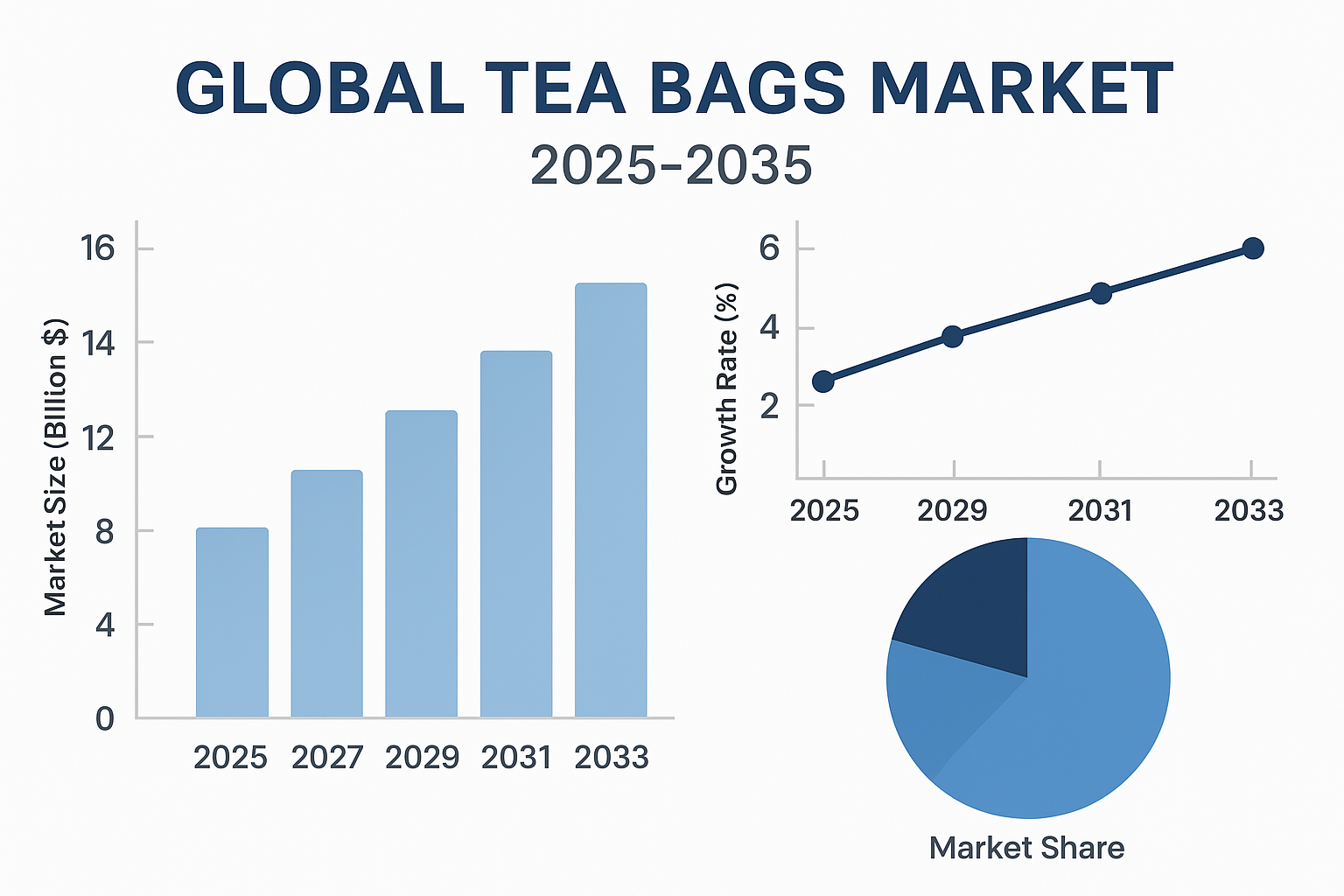
Market Segmentation
The tea bag market is segmented by type, shape, packaging material, distribution channel, and end-user.
By Type (Market Share, 2025)
-
Black Tea: 45% (dominant due to widespread popularity and affordability).
-
Green Tea: 25% (growing due to health benefits like antioxidants and weight management).
-
Herbal Tea: 20% (rising demand for wellness and functional teas).
-
Others (Oolong, White Tea, etc.): 10%.
By Shape
-
Pyramid Tea Bags: Gaining traction for better infusion and premium appeal.
-
Pillow/Square Shaped: Traditional and widely used for cost-effectiveness.
-
Round Shaped: Niche but growing in specialty markets.
By Packaging Material
-
Paper: Dominant due to eco-friendly and recyclable properties.
-
Nylon/Silk: Used in premium segments for enhanced infusion.
-
Biodegradable Materials: Increasing adoption due to sustainability trends.
By Distribution Channel
-
Supermarkets/Hypermarkets: Largest channel due to one-stop shopping convenience.
-
Online Retail: Fastest-growing, driven by e-commerce and customization options.
-
Specialty Stores: Popular for premium and artisanal teas.
-
Convenience Stores: Growing in urban areas for on-the-go purchases.
By End-User
-
Residential: Largest segment, driven by household consumption.
-
Commercial (Cafes, Hotels): Growing due to urban café culture and premium tea demand.
Growth Drivers
-
Health Consciousness: Increasing awareness of tea’s health benefits, particularly green and herbal teas, boosts demand.
-
Convenience: Tea bags offer a mess-free, quick preparation method, appealing to busy lifestyles.
-
Sustainability Trends: Rising demand for biodegradable and plastic-free packaging.
-
Premiumization: Growing preference for specialty, organic, and artisanal tea blends.
-
E-commerce Growth: Online platforms enable wider reach and personalized tea offerings.
-
Innovation: New flavors, functional teas (e.g., detox, immunity), and advanced brewing technologies.
Trends
-
Flavored Tea Bags: 25% growth in demand for unique blends like fruit and spiced teas.
-
Sustainable Packaging: 28% of consumers prefer biodegradable tea bags.
-
Online Sales: Account for 30% of total tea bag sales, with rapid growth expected.
-
Functional Teas: Rising popularity of teas with health benefits (e.g., stress relief, digestion).
Challenges
-
Supply Chain Disruptions: Geopolitical issues (e.g., Russia-Ukraine conflict) impact raw material availability and costs.
-
Competition: Intense rivalry among global and local brands.
-
Raw Material Price Volatility: Fluctuations in tea leaf prices affect profitability.
Key Players
-
Twinings (Associated British Foods Plc.): Known for premium blends and global distribution.
-
Lipton (Unilever): Dominant in mass-market tea bags.
-
Tetley: Strong presence in black tea segments.
-
Celestial Seasonings: Leader in herbal and wellness teas.
-
Bigelow Tea: Focuses on innovative flavors and sustainability.
-
Dilmah: Emphasizes single-origin, organic teas.
-
Numi Organic Tea: Popular for artisanal and organic offerings.
-
Yogi Tea: Known for functional and wellness-focused teas.
-
Harney & Sons: Premium and specialty tea blends.
-
The Republic of Tea: Focuses on unique and health-oriented teas.
Strategic Analysis
-
Product Innovation: Companies are launching new flavors (e.g., Dabur Vedic Green Tea Detox Kahwa, Numi Organic Roasted Japanese Green Tea) and functional teas to cater to health-conscious consumers.
-
Sustainability Initiatives: Brands like Dilmah and Bigelow are adopting eco-friendly packaging to meet consumer demand.
-
E-commerce Expansion: Key players are leveraging online platforms for direct-to-consumer sales and subscription models.
-
Mergers and Partnerships: Example: Unilever’s sale of its tea business (Ekaterra) to CVC Capital Partners in 2021 for €4.5 billion.
Table of Content
1. Market Overview
1.1 Research Methodology
1.2 Definitions and Scope
2.Market - Executive Summary
2.1 Market Opportunity
2.2 Key Trends by Product Segments
2.3 Key Trends by Geography
3. Tea Bags Market Landscape
3.1 Comparative analysis
3.1.1 Product Benchmarking - Top 10 companies
3.1.2 Top 5 Financials Analysis
3.1.3 Market Value split by Top 10 companies
3.1.4 Pricing Analysis
4. Market Forces
4.1 Market Drivers
4.2 Market Constraints
4.3 Market Challenges
4.4 Porter’s Five Forces
4.4.1 Bargaining Power of Suppliers
4.4.2 Bargaining Power of Consumers
4.4.3 Threat of New Entrants
4.4.4 Threat of Substitute Products and Services
4.4.5 Degree of Competition
5. Tea Bags Market - Strategic Analysis
5.1 Value Chain
5.2 Opportunity
5.3 Patent Analysis
6. Global Tea Bags Market Outlook
6.1 Global Tea Bags Market Outlook, by Type, 2025-2035
6.2 Global Tea Bags Market Outlook, by Application, 2025-2035
7. Asia Pacific Tea Bags Market Outlook
7.1 Key Snapshot
7.2 Asia Pacific Tea Bags Market Outlook, by Type, 2025-2035
7.3 Asia Pacific Tea Bags Market Outlook, by Application, 2025-2035
7.4 Asia Pacific Tea Bags Market Outlook, by Country, 2025-2035
8. North America Tea Bags Market Outlook
8.1 Key Snapshot
8.2 North America Tea Bags Market Outlook, by Type, 2025-2035
8.3 North America Tea Bags Market Outlook, by Application, 2025-2035
8.4 North America Tea Bags Market Outlook, by Country, 2025-2035
9. Europe Tea Bags Market Outlook
9.1 Key Snapshot
9.2 Europe Tea Bags Market Outlook, by Type, 2025-2035
9.3 Europe Tea Bags Market Outlook, by Application, 2025-2035
9.4 Europe Tea Bags Market Outlook, by Country, 2025-2035
10. Latin America Tea Bags Market Outlook
10.1 Key Snapshot
10.2 Latin America Tea Bags Market Outlook, by Type, 2025-2035
10.3 Latin America Tea Bags Market Outlook, by Application, 2025-2035
10.4 Latin America Tea Bags Market Outlook, by Country, 2025-2035
11. Middle East and Africa Tea Bags Market Outlook
11.1 Key Snapshot
11.2 Middle East and Africa Tea Bags Market Outlook, by Type, 2025-2035
11.3 Middle East and Africa Tea Bags Market Outlook, by Application, 2025-2035
11.4 Middle East and Africa Tea Bags Market Outlook, by Country, 2025-2035
12. Tea Bags Market -Entropy
12.1 New Product Launches
12.2 M&A, Collaborations, JVs, and Partnerships
13. Tea Bags Market Company Analysis
13.1 Market Share Analysis, Financial Analysis, Product Synopsis, Recent News and Developments
13.2 Company 1
13.3 Company 2
13.4 Company 3
13.5 Company 4
13.6 Company 5
13.7 Company 6
13.8 Company 7
13.9 Company 8
13.10 Company 9
13.11 Company 10
Related Reports
-
Organic Beer Market Report- Global Strategic Analysis, Size, Share, Trend, and Forecast (2025-2035)
- Published: July, 2025
- Price: $2950
- Sample Request
-
Processed Fruit Market Report- Global Strategic Analysis, Size, Share, Trend, and Forecast (2025-2035)
- Published: July, 2025
- Price: $2950
- Sample Request
-
Industrial Enzymes Market Report- Global Strategic Analysis, Size, Share, Trend, and Forecast (2025-2035)
- Published: July, 2025
- Price: $2950
- Sample Request
-
Pasta Market Report- Global Strategic Analysis, Size, Share, Trend, and Forecast (2025-2035)
- Published: July, 2025
- Price: $2950
- Sample Request